To simultaneously achieve high thermal conductivity and impeccable electrical insulation, ceramic fillers are essential. An overview of the three best-performing candidates, their properties and their application limits.
Boron nitride (BN), the “white graphite”
Boron nitride is an inorganic solid whose hexagonal (h-BN) and cubic (c-BN) structures are the most stable. Its hexagonal structure is similar to that of graphite, earning it the nickname “white graphite”.
Key properties
- Thermal conductivity: up to 300-400 W/m·K in the layer plane
- Electrical resistivity: 10¹³ Ohm.cm (excellent electrical insulator)
- Thermal stability: up to 1000 °C in air, 1950 °C in inert gas
- Non-toxic (advantage in terms of industrial handling)
Key result — BN in epoxy: According to Xiao and Xue Du, the thermal conductivity of an epoxy composite increases from 1.5 W/m·K with untreated BN to 2.69 W/m·K when BN is treated by admicelle, a treatment promoting the interfacial adhesion of BN to the resin.
Aluminium nitride (AlN)
A refractory and semi-conducting material, AlN is both an electrical insulator and has exceptional thermal conductivity, which can reach 1800 W/m·K for the purest forms. Its main limitation is its sensitivity to hydrolysis in the presence of water.
Key result of silane-treated AlN in epoxy
- With 60 vol.% of silane-treated AlN particles, thermal conductivity reaches 11.0 W/m·K
- An increase of +97% compared to untreated AlN
- The improvement is due to the reduction in thermal contact resistance at the interface
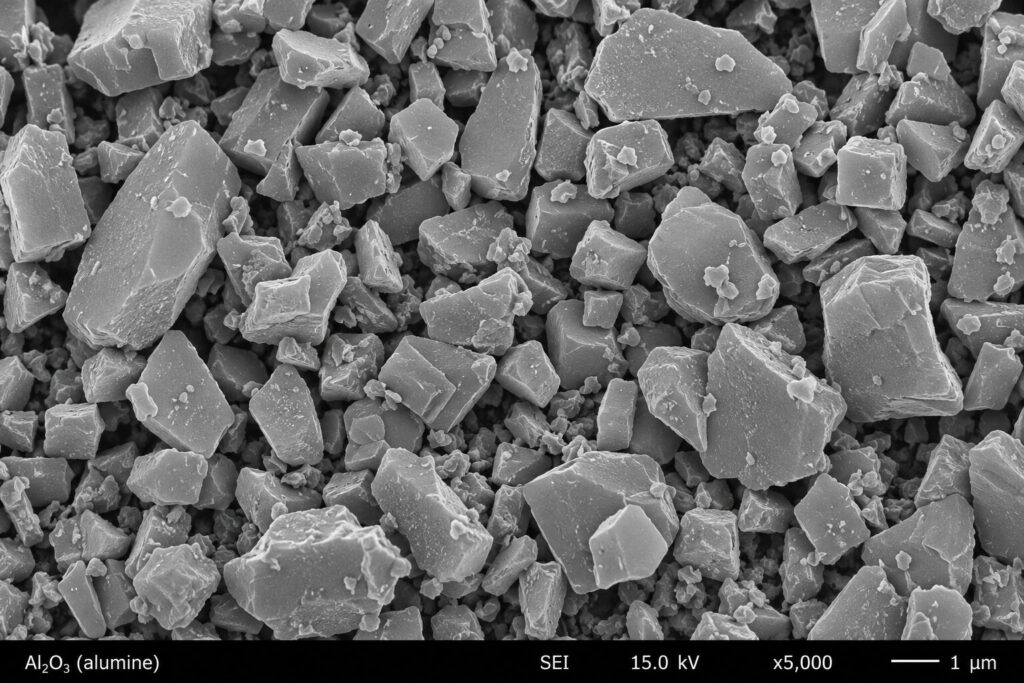
Alumina (Al₂O₃), the general-purpose filler
Part of the oxide family, alumina is the hardest natural material after diamond (> 18 GPa Vickers). It is particularly used for its wear resistance, biocompatibility and excellent performance-to-cost ratio.
- Thermal conductivity: 8-30 W/m·K (depending on purity)
- Dielectric strength: up to 40 kV/mm
- With 80 vol.%: epoxy composite thermal conductivity reaching 4.5 W/m·K
Comparative table of effective conductivities (literature)
| Configuration | Volume fraction | λ effective (W/m·K) | Treatment |
|---|---|---|---|
| Pure epoxy (reference) | – | ~0.2 | – |
| Epoxy + untreated BN | Variable | 1.5 | None |
| Epoxy + admicelle BN | Variable | 2.69 | Admicelle |
| Epoxy + Al₂O₃ | 80 vol.% | 4.5 | – |
| Epoxy + silane-treated AlN | 60 vol.% | 11.0 | Silane |
Note: graphite and graphene. Although graphite and graphene have very high intrinsic thermal conductivities, they are also electrically conductive. Their use is therefore incompatible with dielectric insulation applications.
Do you want to select the right ceramic filler for your thermal composite? Contact our technical team at sales@segdielectriques.com for tailored support.