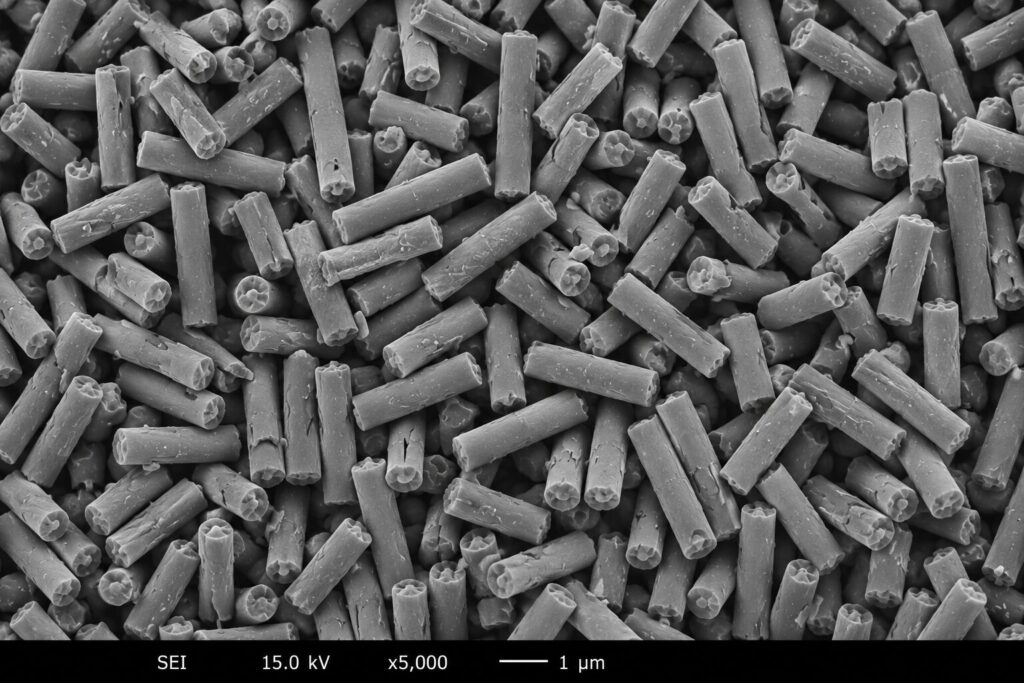
The thermal conductivity of a composite does not depend solely on the nature of the fillers. The shape of the particles, their size, distribution and concentration play an equally decisive role. A breakdown of the key morphological mechanisms.
1. Aspect ratio
The aspect ratio is defined as the ratio between the length and the thickness of a filler (or between the length and diameter for spherical particles). The further it deviates from 1, the more the particles promote contact between them and therefore heat transfer.
| Shape | Aspect ratio | Inter-particle contact | Impact on λ |
|---|---|---|---|
| Sphere | AR = 1 | Low | Unfavourable |
| Prolate (elongated oval) | AR > 1 | Moderate | Moderate |
| Oblate (flattened disc) | AR < 1 | Good | Good |
| Platelet (blade) | AR ≪ 1 | Very high | Excellent |
| Cylinder (fibre) | AR → ∞ | Very high | Excellent |
For hexagonal BN platelets, conductivity in the layer plane can reach ~400 W/m·K, making it the most effective shape for directing heat flux in a preferred direction.
2. Particle size
Filler size comes into play in two ways:
- Specific surface area and filler/matrix interface: small particles create many small interfaces that increase overall thermal resistance. Large fillers, with a lower specific surface area, are therefore preferable for effective conductivity.
- Size combination (jar principle): mixing particles of different diameters optimises packing and maximises the density of the conductive network, similar to the principle of filling a jar with pebbles and sand.
3. Thermal percolation phenomenon
The percolation threshold corresponds to the critical volume fraction at which the particles form a continuous network in the matrix, creating preferred paths for thermal conduction.
| Below threshold | At percolation threshold | Above threshold |
|---|---|---|
| Isolated particles in matrix. Low conductivity improvement. Rate < 10 vol.%. | First continuous conductive network formed. Significant improvement. Progressive transition for λ. | Dense, interconnected network. Strong improvement in λ. Rate > 50 vol.% required. |
4. Volume fraction (filler content)
The volume fraction represents the percentage of fillers over the total volume of the composite material. Its influence on effective conductivity is non-linear:
- Rate < 10 vol.%: low improvement, filler network is non-existent
- Rate 10-50 vol.%: progressive improvement, first network forming
- Rate > 50 vol.%: strong impact on effective λ, but risk of high viscosity
Warning: Increasing the filler content also increases the number of filler/matrix interfaces, which tends to reduce local heat transfer. Particle size distribution and morphology must therefore be optimised jointly with the volume fraction.
5. Interactions between fillers: synergistic effects
Some studies mention the combination of fillers of different natures and shapes to obtain synergistic effects. For example, Zhifang Gao and Lei Zhao showed that a mixture of AlN and Al₂O₃ nanoparticles achieves 0.57 W/m·K with low volume fractions. Dual-filler synergies can provide an additional gain of 20 to 40% on effective conductivity.
Do you want to optimise the morphology of fillers in your thermal composite? Contact our technical team at sales@segdielectriques.com for tailored support.