From filler selection to processing optimisation, every technical decision influences the final thermal conductivity of the composite. This guide summarises the selection criteria and best practices for dielectric insulation applications.
Ceramic filler selection table
| Filler | Therm. cond. | Elec. insul. | Cost | Processing | Recommended use |
|---|---|---|---|---|---|
| h-BN platelets | High | Excellent | High | Orientation req. | Power electronics |
| AlN (silane-treated) | Very high | Good | Medium-high | High rate req. | SiC/GaN modules |
| Al₂O₃ alumina | Moderate | Very good | Low | Easy | Transformers |
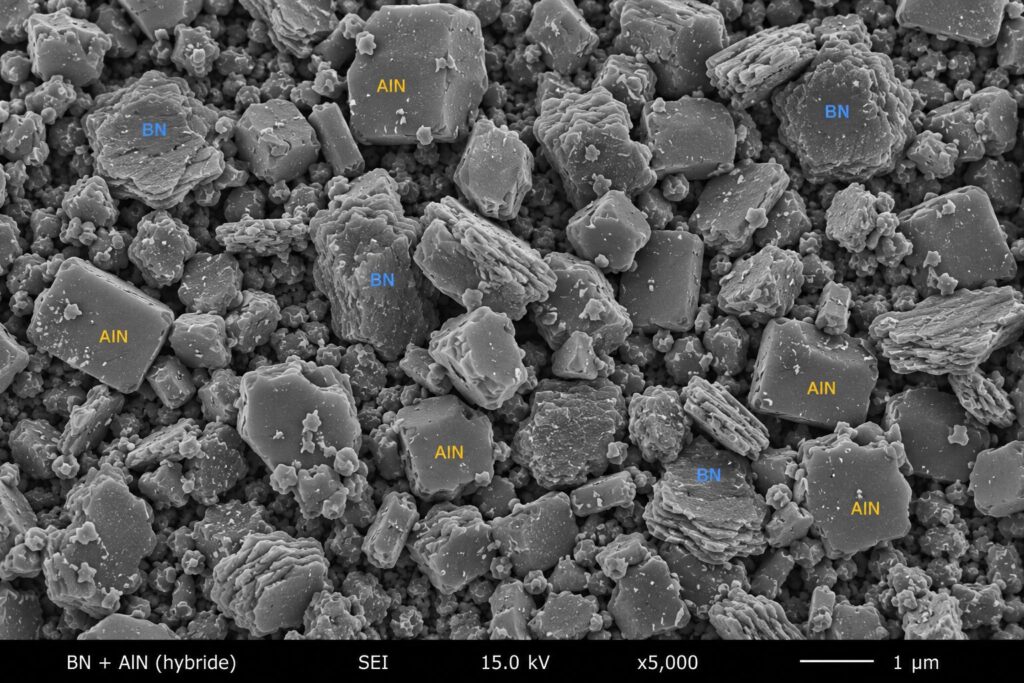
| Hybrid BN + AlN | High | Good | Medium | Synergies to validate | High performance |
| Al(OH)₃ | Low | Good | Very low | Critical viscosity | Flame retardancy |
Typical industrial applications
High thermal conductivity and electrical insulation composites find applications in four main industrial sectors:
- Transformers: Thermal dissipation + dielectric strength. Recommended filler: Al₂O₃ or h-BN.
- SiC/GaN modules: Critical thermal interfaces, flux > 50 W/cm². Filler: silane-treated AlN.
- Electric vehicles: Batteries and inverters. Weight and vibration constraints. Filler: h-BN platelets.
- Aerospace: Extreme environments > 200 °C. 3D printing. Filler: h-BN in high-Tg epoxy.
Optimisation methodology: 5 key steps
- Define application constraints: Target thermal conductivity, minimum dielectric strength, temperature range, mechanical requirements and cost constraint.
- Select the filler and its morphology: Prefer platelets or cylinders for aspect ratio. Combine two complementary particle sizes to optimise network density (jar/pebbles/sand principle).
- Treat surfaces (functionalisation): Silane for AlN, admicelle for h-BN. This treatment reduces interfacial thermal resistance and can double the effective conductivity of the composite.
- Optimise volume fraction: Determine the percolation threshold. Target 50-60 vol.% for maximum performance while ensuring that the resin viscosity remains compatible with the processing method.
- Validate dual-filler synergistic effects: Test dual-filler combinations (AlN + Al₂O₃, BN + AlN). Synergies can provide an additional gain of 20-40% on effective thermal conductivity.
Trends 2025-2026. The electrical insulation materials market is growing strongly (+6.6%/year). Applications related to electric vehicles, energy management systems and renewable energies are driving demand towards high thermal conductivity composites combining hybrid fillers and advanced surface treatments.
Do you want to choose and optimise the right thermal filler for your dielectric application? Contact our technical team at sales@segdielectriques.com for tailored support.